The intelligent of ships makes its debut, inaugurating a new era of intelligent navigation on inland rivers.
In March this year, at the symposium on the high - quality development of inland river new - energy ships held by the Baima River in Zoucheng, Jining, Shandong, the brand - new intelligent ship cockpit was officially unveiled. As an important practice for the intelligent upgrade of inland river new - energy ships, this cockpit further enhances the cockpit space experience, information integration ability, and intelligence level around scenarios such as ship construction, navigation control operation, operation monitoring, ship - shore collaboration, and subsequent operation and maintenance.
01 From "Equipment Stacking" to "Human - Ship - Shore - Data" Collaboration
For a long time, inland river ship cockpits have generally suffered from problems such as a high degree of non - standardization, scattered equipment interfaces, inconsistent data interfaces, and insufficient ship - shore information linkage. During actual navigation, crew members need to frequently switch between multiple instruments, screens, and control devices, which easily increases cognitive load and operational pressure. In scenarios such as long - term on - duty, navigation in complex waters, and night navigation, the information presentation mode and operation logic of the cockpit directly affect the crew's judgment efficiency and the ability to ensure navigation safety. The value of the intelligent cockpit is not just to replace several traditional instruments or increase the number of display screens, but to conduct a systematic reconstruction around crew operations, ship status, shore - based collaboration, and data governance. Through unified space layout, unified interaction logic, unified data access, and unified application hosting, the cockpit has gradually been upgraded from a traditional "equipment - stacking space" to an integrated navigation control platform for intelligent navigation.
Design renderings: Design of the integrated navigation console for the new stage of intelligent navigation
02 Human - Centered to Improve the Cockpit Experience
In terms of space and human - factors design, the intelligent cockpit focuses on the long - term navigation scenarios of crew members, emphasizing operational accessibility, information readability, and environmental comfort. By integrating scattered navigation control devices, the cockpit surface becomes more concise, and the key devices and core operation areas are more concentrated, which helps to reduce the crew's line - of - sight shifts and repetitive operations during navigation.
In terms of visual and spatial expression, the intelligent cockpit weakens the industrialized and fragmented feeling of traditional ship cockpits. It adopts a more technological and integrated spatial language to relieve the crew's fatigue during long - term navigation. There are ingenious designs in the details. The hidden handrails on the edge of the console combine practicality and aesthetics. The adjustable multifunctional seats are ergonomic, and the surround - style navigation control layout makes core operations easily accessible, truly implementing the "human - centered" concept.
03 Information Integration as the Core for a Clearer Navigation Control Interface
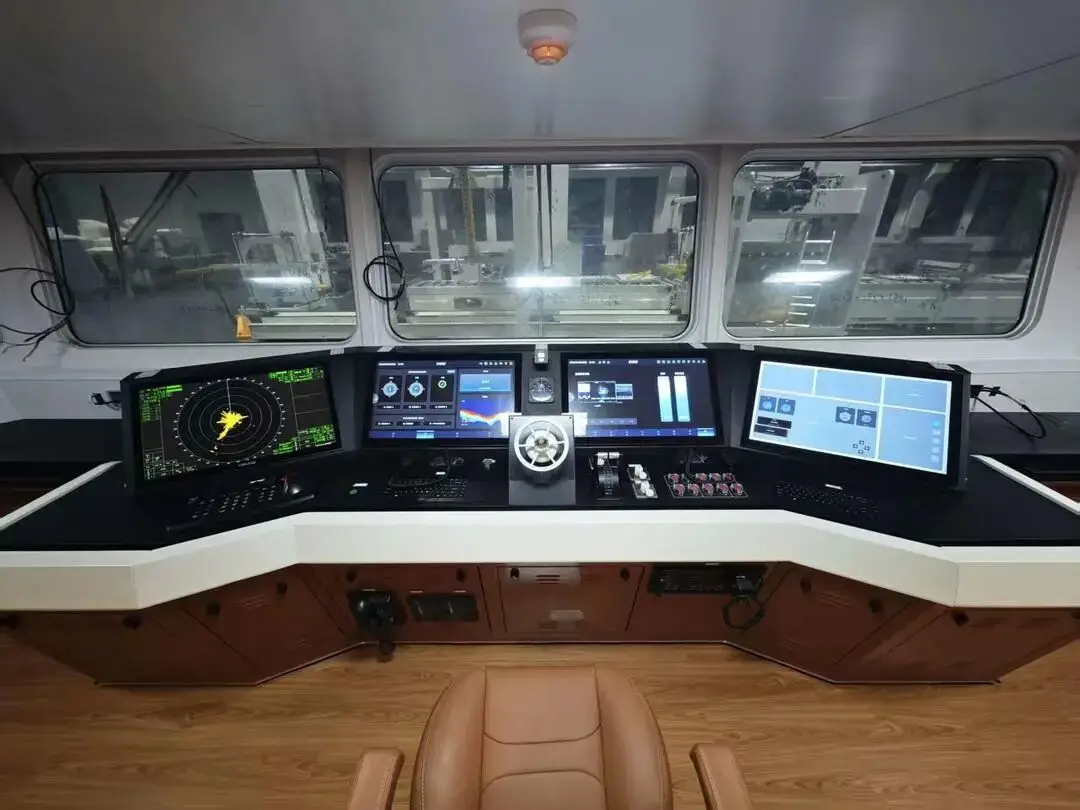
In terms of interaction and function integration, the intelligent cockpit uses multi - screen display and HMI (Human - Machine Interface) interaction design to present information on navigation, equipment, alarms, videos, and auxiliary decision - making in a centralized manner. We have reconstructed the HMI interaction logic, integrated the ship's core systems, and achieved "one - screen overview, one - button operation, and one - network collaboration", covering all scenarios such as navigation, monitoring, alarms, and auxiliary decision - making.
By integrating the data of devices such as AIS (Automatic Identification System), Beidou, and depth sounders, the navigation information and ship status are presented centrally, and the auxiliary equipment and video monitoring are integrated for management and control. Through functions such as situation awareness, safety monitoring, intelligent interaction, and intelligent assistants, the cockpit can provide the crew with more timely and intuitive auxiliary information, improving daily operation efficiency and the ability to ensure navigation safety.
Project real - shot photos: Multi - screen information presentation and layout of the core operation area
04 Data Base to Support Subsequent Intelligent Expansion
The key to ship intelligence lies not only in the upgrade of single - point functions but also in whether data can be continuously accessed, managed, reused, and expanded. We have built a full - link data governance system for the intelligent cockpit. Through the unified collection, protocol adaptation, and standardized processing of ship - end equipment data, it provides basic support for subsequent applications such as assisted driving, remote operation and maintenance, intelligent alarms, energy consumption analysis, and ship - shore collaboration.
On the edge side, the system can deploy edge computing and local data processing capabilities according to project configurations, and conduct timely analysis and provide prompts for key navigation information, equipment status, and safety risks. On the shore - based side, by connecting to the ship - shore collaboration platform, it provides a data channel for remote operation and maintenance, status monitoring, scheduling management, and operation analysis. As the application scenarios continue to expand, the data base will also become an important foundation for the whole - life - cycle management of ships and the continuous iteration of intelligence.
Design renderings: Spatial expression of the intelligent cockpit for new - energy ships
05 From a Single Product to a Systematic Solution
For shipyards and shipowners, the significance of the intelligent cockpit lies in forming an intelligent solution that can be replicated, integrated, and iterated. On the one hand, the standardized cockpit design helps to reduce the repetitive work in the development and integration of new ships and improve the adaptation efficiency of subsequent series of ship types. On the other hand, the unified data and interaction platform helps to reduce equipment fragmentation and system silos, leaving room for subsequent function upgrades.
Around the actual application requirements of inland river new - energy ships, the intelligent cockpit can cover various scenarios such as the integrated supporting of new ships, the intelligent transformation of existing ships, the access to ship - shore collaboration systems, and the construction of remote operation and maintenance capabilities. In the future, as the requirements for intelligent navigation, green shipping, and digital ship management continue to increase, the cockpit will no longer be just a space for crew operation but will become a key node connecting ships, personnel, equipment, shore - based facilities, and data platforms.
Full - chain integration ability
Beyond products, it's about the system
The unveiling of this intelligent ship cockpit is an important practice in the intelligent development of inland river new - energy ships. It integrates space design, human - factors engineering, interaction experience, equipment integration, data governance, and ship - shore collaboration capabilities, providing new ideas for the upgrade of the traditional inland river ship navigation control mode.
Our company participated in the intelligent ship cockpit project.
Looking to the future, the intelligent competition in inland river shipping will no longer be limited to single equipment or individual functions but will revolve around the whole - ship system integration ability, ship - shore collaboration ability, continuous data operation ability, and scenario - based application ability. In the current field of intelligent equipment for inland river shipping, many enterprises only focus on a single link, such as focusing on styling, developing software, or supplying equipment. It is difficult for them to form a closed - loop solution and solve the full - process pain points of shipbuilding enterprises. As a system integrator, we have built eight core capabilities, covering the entire chain from design, R & D, integration to implementation, operation and maintenance, and iteration, and created a complete ecological system for inland intelligent cockpits.
We provide not only hardware products but also a comprehensive service system - standardized design, customized integration, full - cycle operation and maintenance, and continuous technology iteration, effectively solving the operational problems of shipbuilding enterprises. Whether it is the integrated supporting of new ships or the intelligent upgrade of existing ships, we can provide suitable solutions to help inland river shipping move from "traditional navigation control" to "intelligent navigation" and jointly promote the high - quality development of the industry.